Earlier this year, Huawei launched its Pura 90 Pro and 90 Pro Max exclusively for the Chinese market. Now, the company is taking a new step — introducing a pair of “90s” models that share much of the same hardware, but this time, these phones will be sold across the world.
Here’s a question worth asking — if Chinese consumers already had access to this technology months ago, why did the rest of the world have to wait so long?
Two Phones, One Shared DNA
The Pura 90s Pro and Pro Max have a lot in common. The differences lie mainly in screen size (6.6 inches for the Pro, 6.9 inches for the Pro Max), charging speed, and the telephoto camera.
The Pro Max’s Biggest Claim: A 200MP Camera
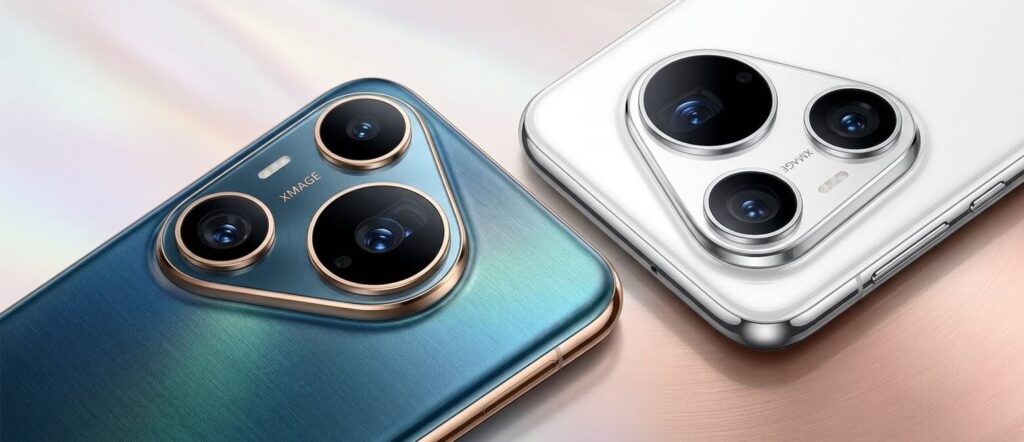
Now let’s talk about what’s generating the most buzz — the Pura 90s Pro Max’s camera. It features the industry’s first 200MP RYYB sensor. Worth remembering here — Huawei has a long-standing pattern of preferring yellow sub-pixels over green ones.
This is a large 1/1.28-inch sensor sitting behind an f/2.6 lens, offering 4x optical zoom. This time, the zoom is fixed — the switchable-lens complexity of last year’s Pura 80 Ultra has been dropped. But thanks to real-time RAW processing, 20x telephoto video is still possible. The lens offers 7-stop stabilization and is capable of macro shots too.
The main camera is also a 1/1.28-inch sensor with 50MP resolution — and it’s a RYYB sensor as well, equipped with LOFIC technology that widens the dynamic range. It replaces last year’s 1-inch sensor found on the Pura 80 Pro and Ultra. The lens comes with OIS, and its aperture adjusts from f/1.4 to f/4.0 across ten steps. There’s also a 40MP ultra-wide camera, also using a RYYB sensor.
The Pro Model: A Bit Less, Still Plenty
The Pura 90s Pro also gets a 4x telephoto camera, though this one carries a 50MP sensor — with OIS, an f/2.1 lens, and macro mode down to 5cm.
The main camera mirrors the Pro Max — 50MP, 1/1.28-inch, RYYB sensor — just without the LOFIC technology. The ultra-wide camera is more basic too, at 12.5MP, also with a RYYB sensor.
Display and Design
The Pro model has a 6.6-inch LTPO panel with a 1-120Hz refresh rate and 1,256 x 2,760px resolution. It’s a flat panel, protected by second-generation Kunlun Glass.
The Pro Max is larger, with a 6.9-inch display, the same 1-120Hz LTPO panel, 1,308 x 2,880px resolution, and original Kunlun Glass. Both displays feature a special optical design that reduces reflections by up to 70%. The company claims a diamond-like carbon coating combined with silicon nitride ceramic boosts scratch resistance 16 times and drop resistance 25 times.
The Chip and Connectivity: A New Chapter
Both phones run on the Kirin 9030S — a brand-new, still somewhat mysterious chip from HiSilicon (the previous Pura 80 generation used the Kirin 9020). The real test will come once it’s actually put to use.
One major shift this generation — the phones now support 5G, something absent from Huawei’s previous global phones. eSIM support has also been added. Other connectivity includes dual-band Wi-Fi 7, Bluetooth 6.0, and NearLink E2.0, Huawei’s own alternative to Bluetooth.
Here’s the question — is this a genuine “comeback” to the global market, or simply a step that was long overdue?
RAM, Storage, and Software
Both phones come with 12GB of RAM and 256GB or 512GB storage options. Rather than standard Android, they run on EMUI 16, built on top of AOSP 16.
Battery: A Different Story for China and the World
Both China and the global market get 6,000mAh batteries — but EU regulations mean the units sold within the Union have a reduced capacity of 5,500mAh, for both models. The Pro Max charges faster, at 100W wired and 80W wireless, compared to the Pro model’s 66W and 50W.
And another question arises — when the technology is identical, why does regulation alone result in the same phone being sold with two different battery capacities?